
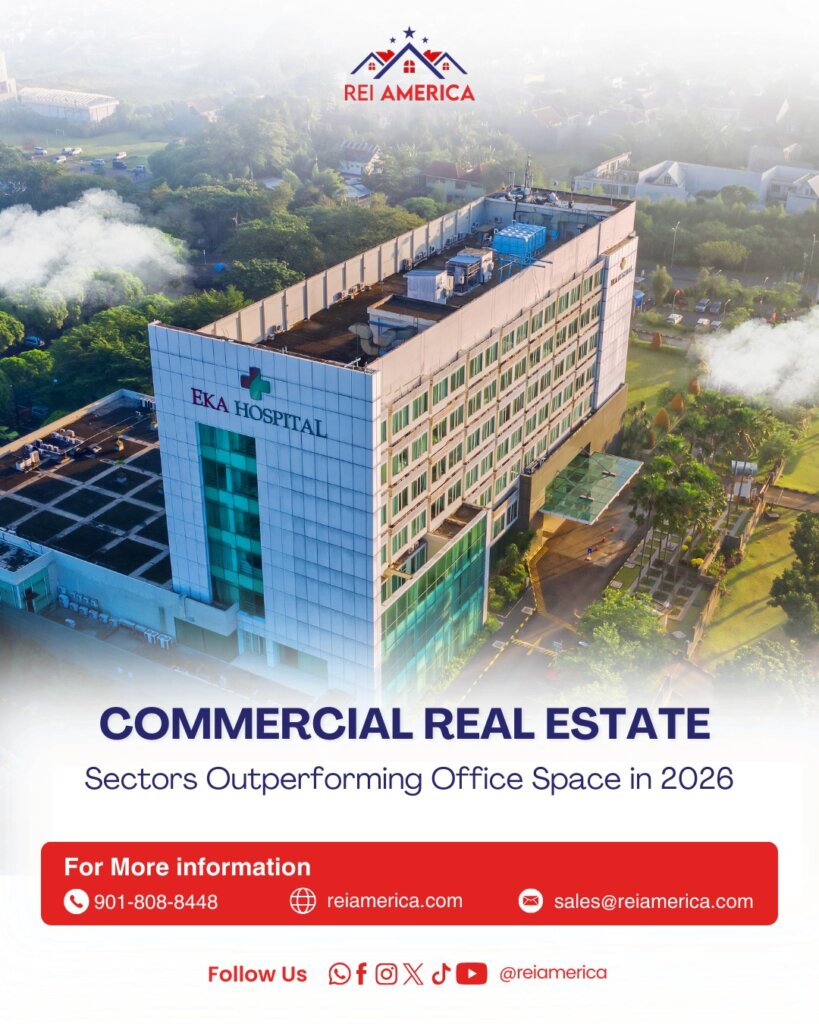
The commercial real estate landscape is shifting rapidly in 2026. While traditional office spaces continue to face challenges from remote work trends and corporate downsizing, several other commercial real estate sectors are outperforming office properties in both stability and returns.
For investors looking to reposition their portfolios, understanding where capital is flowing—and why—is critical. At REI America, we closely track national trends and local market performance to help investors identify high-performing asset classes.
In this article, we’ll break down the top commercial real estate sectors outperforming office space in 2026, why they’re thriving, and how investors can strategically capitalize on these opportunities.
Why Office Space Is Under Pressure in 2026
Before exploring outperforming sectors, it’s important to understand why office real estate is lagging:
- Hybrid and remote work models remain standard
- Corporate space consolidation continues
- Higher vacancy rates in urban cores
- Increased operating and retrofit costs
- Tenant demand shifting toward flexible layouts
As a result, investors are pivoting toward asset classes with stronger demand fundamentals and more resilient income streams.
1. Healthcare Real Estate (Medical Offices & Hospitals)
Healthcare real estate is one of the strongest-performing commercial sectors in 2026.
Why It’s Outperforming:
- Aging U.S. population increasing medical demand
- Growth in outpatient and specialized clinics
- Long-term leases with healthcare operators
- Recession-resistant tenant base
Medical office buildings (MOBs), surgical centers, and specialty clinics offer predictable income and lower volatility compared to traditional office space.
Investor Insight: Properties near major hospitals and expanding suburban healthcare hubs are showing particularly strong absorption rates.
2. Industrial & Logistics Properties
The industrial sector continues to dominate commercial real estate performance in 2026.
Key Drivers:
- E-commerce growth
- Supply chain restructuring
- Demand for last-mile distribution centers
- Manufacturing reshoring in the U.S.
Warehouses, distribution centers, and fulfillment hubs are experiencing low vacancy rates and rising rents, making them attractive for long-term investors.
Cities with strong logistics infrastructure—such as Memphis, known for its transportation and distribution networks—remain top investment targets.
3. Retail Reimagined: Grocery-Anchored & Essential Retail
While traditional malls struggle, essential retail is outperforming.
High-Performing Retail Assets:
- Grocery-anchored shopping centers
- Pharmacy-anchored strip centers
- Discount retailers
- Service-based retail (gyms, salons, quick-service restaurants)
These properties benefit from consistent consumer foot traffic and necessity-based spending.
Why Investors Like It:
- Stable tenants
- Community-focused locations
- Strong renewal rates
- Predictable cash flow
4. Multifamily Apartment Developments
Although technically residential, multifamily remains one of the top-performing income-producing commercial assets.
Why Multifamily Is Strong in 2026:
- Housing affordability challenges
- Rising mortgage rates
- Migration into secondary markets
- Continued rental demand
Investors favor multifamily properties because of diversified income (multiple tenants) and steady occupancy levels.
Secondary markets with job growth and infrastructure expansion continue to outperform larger, oversaturated metros.
5. Data Centers & Tech Infrastructure
One of the fastest-growing commercial real estate sectors in 2026 is data center development.
Driving Factors:
- AI expansion
- Cloud computing growth
- Increased digital storage needs
- Corporate data security investments
These specialized assets offer:
- Long-term corporate leases
- High credit-quality tenants
- Strong demand fundamentals
While capital-intensive, data centers provide scalable, future-proof investment opportunities.
6. Self-Storage Facilities
Self-storage continues to be a quiet but consistent performer.
Why It Works:
- Population mobility
- Downsizing trends
- Small business storage demand
- Lower operational costs
Self-storage assets typically show strong margins and resilience during economic slowdowns.
7. Mixed-Use Developments
Investors are increasingly favoring mixed-use projects that combine:
- Residential
- Retail
- Office (flexible formats)
- Entertainment
These developments create live-work-play environments, reducing reliance on a single asset type and improving long-term stability.
What This Means for Commercial Real Estate Investors
In 2026, successful investors are:
- Diversifying beyond traditional office space
- Targeting recession-resistant sectors
- Prioritizing essential services
- Focusing on markets with strong job growth
- Investing in infrastructure-driven cities
Office space is not disappearing—but it’s evolving. Investors who adapt to these structural shifts are positioning themselves for stronger returns.
How REI America Helps Investors Capitalize on 2026 Trends
At REI America, we specialize in identifying high-performing commercial and income-producing properties in growth-focused markets.
Whether you’re looking to invest in:
- Healthcare facilities
- Industrial properties
- Essential retail
- Multifamily developments
Our team provides data-driven insights, acquisition support, and long-term portfolio strategy.
Final Thoughts: The Future of Commercial Real Estate
Commercial real estate in 2026 is not declining—it’s transforming.
While office space faces structural challenges, sectors tied to healthcare, logistics, essential retail, multifamily housing, and technology infrastructure are outperforming and attracting significant capital.
Investors who understand these shifts and act strategically will continue to build stable, income-producing portfolios in the years ahead.
📞 Ready to Explore High-Performing Commercial Opportunities?
Connect with REI America today:
📍 Website: https://reiamerica.com
📧 Email: sales@reiamerica.com
📞 Phone: 901-808-8448
